

LVT Flooring Meaning: What Does LVT Mean and Why Is It Popular in Dubai?
Luxury Vinyl Tile has become one of the most requested flooring materials in Dubai, and yet most people buying it couldn’t tell you what’s actually inside the plank or why it performs the way it does. If you’ve ever wondered what does LVT mean beyond the marketing term, or whether it can genuinely hold up in Dubai’s heat, dust, and humidity, this guide covers everything the layers, the types, the real pros and cons, and the details most articles on this topic skip entirely.
What Is LVT Flooring?
LVT stands for luxury vinyl tile, a type of vinyl flooring engineered to replicate the look of natural materials such as wood, stone, or marble. It has become a popular choice for both residential and commercial spaces across Dubai, from apartments in Dubai Marina to offices in Dubai Design District, largely because it delivers a high-end appearance without the cost or maintenance burden of natural materials.
LVT flooring meaning goes beyond just “vinyl that looks nice.” It’s manufactured using layered construction technology, typically combining a vinyl core, a photographic design layer that creates the realistic wood, stone, or marble pattern, and a protective wear layer on top that determines how long the floor holds its appearance under daily use.
When people ask what does LVT mean for everyday living, the short answer is: a flooring product that looks like an expensive natural material, costs a fraction of the price, and requires very little upkeep to keep looking that way for years.
The Layer Construction: What LVT Floors Are Made Of
Understanding the layer structure explains why LVT performs so differently from standard vinyl sheeting, and it’s worth knowing before comparing products.
| Layer | What It Does |
|---|---|
| Wear Layer | Clear top coat that resists scratches, stains, and everyday wear |
| Design/Print Layer | High-resolution photographic layer creating the wood, stone, or marble look |
| Core Layer | Vinyl or rigid-core layer providing stability, dent resistance, and sound absorption |
| Backing Layer | Bottom support layer, often adding moisture resistance |
The wear layer is the detail most buyers overlook, and it shouldn’t be. A thin wear layer might look identical to a thicker one on day one, but in a high-traffic hallway or a home with kids and pets, that difference shows up within a year or two as visible scuffing. For Dubai homes specifically, where fine desert sand acts almost like sandpaper underfoot over time, a wear layer of at least 0.3mm ideally 0.5mm or higher for busy households is worth asking about directly rather than assuming all LVT is built the same.
Also Read: Which Type Of Flooring Is Right for Your Dubai Homes in 2026?
Types of LVT Flooring
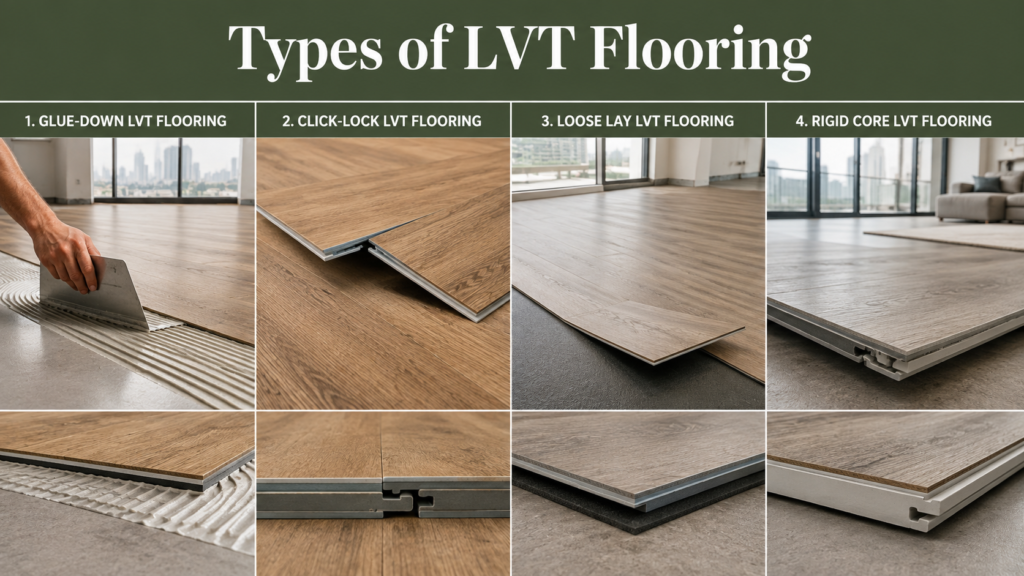
There are several installation types to choose from, each suited to different spaces, subfloor conditions, and budgets.
(i). Glue-Down LVT Flooring
This type is installed using adhesive, creating a stable, secure bond with the subfloor. It’s a strong option for high-traffic commercial spaces and areas that need a very low, seamless profile, though it requires a perfectly level subfloor and professional installation.
(ii). Click-Lock LVT Flooring
Click-lock LVT uses a simple interlocking edge system, making it one of the easier types to install without adhesive. It’s a popular choice for residential projects and can often be laid directly over existing flooring, cutting down renovation time considerably.
(iii). Loose Lay LVT Flooring
Loose lay LVT sits on the subfloor without full adhesive, held in place by its own weight and backing friction, sometimes with adhesive only at the perimeter. This format suits smaller spaces or areas where future access to the subfloor might be needed.
(iv). Rigid Core LVT Flooring
Rigid core LVT features a denser, more stable core than standard flexible vinyl, making it a better fit for slightly uneven subfloors. It also offers improved sound absorption, which matters in Dubai apartments where building regulations often require impact-noise reduction between floors.
| LVT Type | Installation Method | Best For |
|---|---|---|
| Glue-Down | Adhesive to subfloor | Commercial, high-traffic areas |
| Click-Lock | Interlocking edges, no glue | Residential, quick renovations |
| Loose Lay | Weighted, minimal adhesive | Smaller spaces, easy access needs |
| Rigid Core | Interlocking, dense core | Uneven subfloors, apartments |
Advantages of LVT Flooring
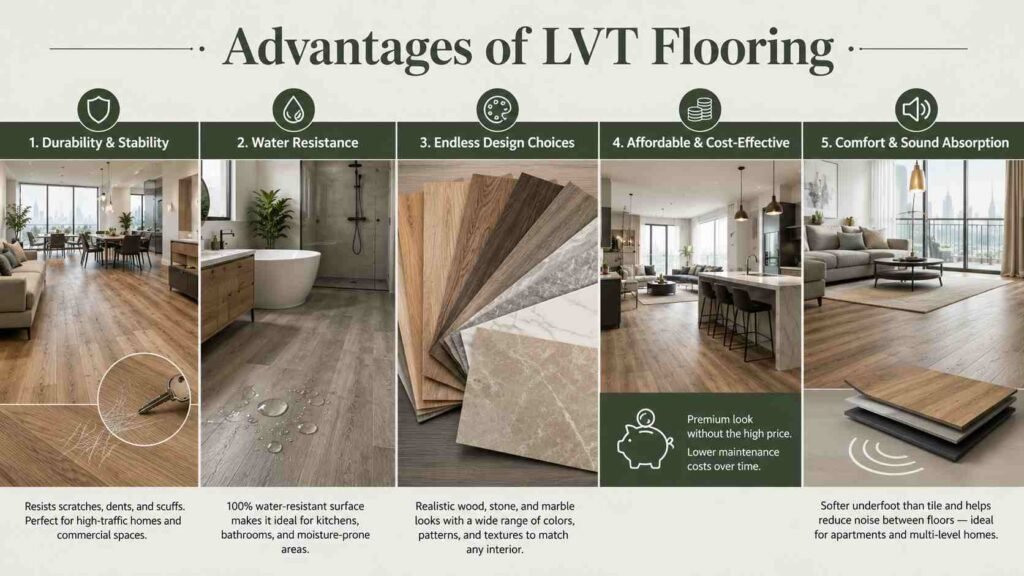
LVT’s popularity isn’t accidental. It solves several real problems that other flooring materials struggle with, particularly in a demanding climate like Dubai’s.
(i). Durability and stability for any space.
The protective wear layer resists scratches, dents, and scuffs, which makes it a practical choice for family homes, restaurants, hotels, and offices alike. It holds up to pet claws, dropped toys, heavy furniture, and constant foot traffic without wearing down quickly.
(ii). Water resistance.
LVT’s water-resistant properties make it suitable for kitchens, bathrooms, and any moisture-prone area, where spills and leaks won’t damage the flooring the way they would with wood-based materials.
(iii). Endless design choices.
The photographic design layer allows LVT to replicate wood grain, stone veining, or marble patterns with genuine realism, giving homeowners far more design flexibility than natural materials alone would allow at the same price point.
(iv). Affordable and cost-effective.
Despite the “luxury” name, LVT is one of the more budget-friendly flooring materials available, with lower long-term maintenance costs than natural wood or stone.
(v). Comfort and sound absorption
LVT feels noticeably softer underfoot than porcelain or ceramic tile, and its layered construction helps absorb sound, which is a genuine benefit in multi-level homes or apartments with strict noise regulations.
What Most Guides Don’t Tell You: The Gaps Worth Knowing
Most LVT articles stop at the basic pros and cons. Here’s what actually matters once you’re comparing real products for a Dubai property.
Wear Layer Thickness by Use Case
| Wear Layer Thickness | Recommended Use |
|---|---|
| 0.1mm – 0.2mm | Light residential use, low-traffic rooms |
| 0.3mm | Standard residential, moderate traffic |
| 0.5mm | Busy households, pets, high-traffic hallways |
| 0.7mm+ | Commercial spaces, retail, offices |
Subfloor Preparation Requirements
LVT is forgiving, but not infinitely so. Click-lock and rigid-core products can typically be floated over existing flat tile, but any subfloor with visible dips, cracks, or unevenness beyond a few millimeters needs leveling compound before installation skipping this step is one of the most common reasons an otherwise good LVT floor develops visible seams or lifting over time.
LVT Pricing in Dubai
| LVT Type | Material Cost (AED/sqm) | Installation (AED/sqm) | Total Installed |
|---|---|---|---|
| Standard Click-Lock LVT | 45 – 70 | 20 – 28 | 65 – 98 |
| Premium Click-Lock LVT | 80 – 150 | 25 – 35 | 105 – 185 |
| Glue-Down LVT (Commercial) | 60 – 130 | 30 – 45 | 90 – 175 |
Eco-Friendliness: A Fair Look
LVT is a synthetic, PVC-based product, and it’s worth being upfront that this makes it less eco-friendly than natural wood or stone by default. That said, many manufacturers now produce LVT with recycled core content and lower-emission manufacturing processes, so if sustainability matters to you, it’s worth asking suppliers directly about recycled content percentages rather than assuming all LVT is equal on this front.
Commercial-Grade vs Residential-Grade LVT
Commercial LVT typically uses a thicker wear layer and denser core than residential-grade products, since it’s built to handle far higher foot traffic in offices, hotels, and retail spaces. If you’re fitting out a commercial property in Dubai, buying residential-grade LVT to save money often backfires within a year or two as the wear layer breaks down faster than expected.
LVT Flooring in Dubai’s Climate
Vinyl flooring in Dubai has to deal with conditions most international guides never account for constant AC cycling, intense summer heat, and fine desert sand that settles indoors within days of a window being left open.
LVT performs well here specifically because its vinyl core doesn’t expand, warp, or absorb moisture the way wood-based materials can under Dubai’s heat and humidity swings. Its flat, smooth surface is also considerably easier to keep clean of dust and sand than heavily textured materials, which matters given how quickly fine sand accumulates indoors in this climate.
For apartments with building restrictions on heavier flooring, LVT’s floating, click-lock installation is often the practical choice since it can typically be laid directly over existing tiles without demolition a real advantage for renters and owners looking to update a space quickly.
LVT Flooring Maintenance: How to Clean LVT Floors
One of LVT’s biggest practical advantages is how little upkeep it demands. Unlike natural wood or stone, LVT floors don’t require sealing, waxing, or specialised cleaning products.
To maintain the appearance and longevity of your LVT flooring, regular sweeping or vacuuming to remove dust and debris is generally enough for day-to-day care. For a deeper clean, mopping with a damp cloth and a mild detergent handles most build-up without any risk to the floor’s finish.
In Dubai specifically, the extra step worth adding is a doormat at every entry point, since this single habit meaningfully reduces how much sand gets tracked onto the floor and worn into the surface over time.
Where to Buy LVT Flooring in Dubai
Dubai Flooring Co. A trusted flooring company Dubai,supplies and installs LVT flooring including click-lock, glue-down, loose lay, and rigid core options for residential and commercial spaces across Dubai, alongside our full range of SPC, vinyl, wood, and specialty flooring solutions.
Phone / WhatsApp: +971 52 553 4055
Website: dubaiflooringco.com
Address: 26th St – Al Quoz First – Dubai, UAE
Frequently Asked Questions
What exactly is LVT flooring?
LVT stands for luxury vinyl tile, a layered flooring product designed to replicate wood, stone, or marble while offering better durability, water resistance, and easier maintenance than the natural materials it imitates.
What is the downside of LVT flooring?
LVT is less eco-friendly than natural materials since it’s synthetic, and improper installation on an uneven subfloor can shorten its lifespan and cause visible seams.
Which is better, LVT or LVP flooring?
Neither is universally better LVT typically mimics stone or tile, while LVP replicates wood planks, and both share similar durability, water resistance, and maintenance needs.
What material is LVT made of?
LVT is built from a vinyl core, a photographic design layer that replicates natural materials, and a protective wear layer on top for durability.
Is LVT better than laminate?
LVT generally outperforms laminate on water resistance and durability, making it a safer choice for kitchens, bathrooms, and other moisture-prone rooms.
How long does LVT flooring last?
With proper installation and maintenance, LVT flooring typically lasts 10 to 20 years, and longer for higher-quality products with a thicker wear layer.
Is LVT flooring waterproof?
Most click-lock LVT products are fully waterproof, while glue-down versions are highly water-resistant but can be more vulnerable at the seams.
Is LVT flooring suitable for Dubai’s climate?
Yes LVT flooring resists the heat and humidity swings that can cause wood-based flooring to warp, and its smooth surface is easier to keep clean of dust and sand than textured alternatives.
Understanding LVT flooring meaning helps explain why this material has become popular in Dubai. LVT earns its popularity by giving homeowners and businesses the appearance of natural wood, stone, or marble without the cost, maintenance, or climate sensitivity that comes with real materials. Before buying, it’s important to understand the layer construction, wear layer thickness, and installation type to choose a floor that can hold up to years of daily use in a Dubai home or office.