

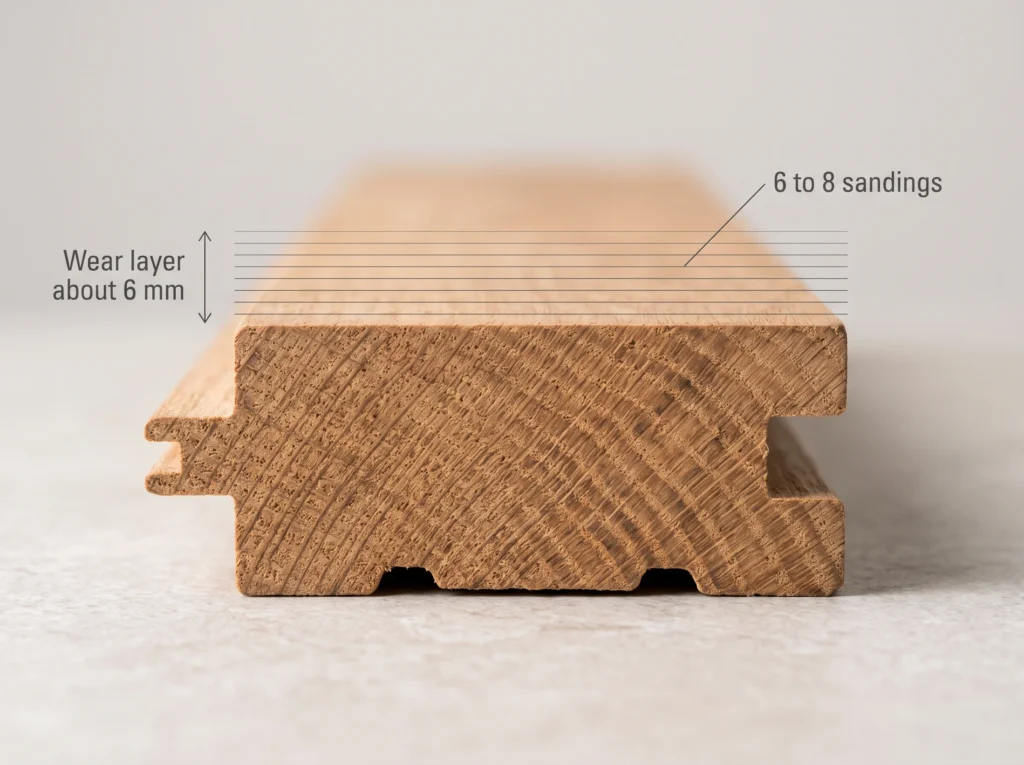
How long does solid wood flooring last? Probably longer than you’ll live in the same house. Flooring refinishers often put a well-kept solid floor at 80 to 100 years or more, and most can be sanded back to fresh, new-looking wood 6 to 8 times, according to the National Wood Flooring Association (NWFA).
But here’s the catch. Every sanding shaves a thin layer off the top, and once that wood is gone, it’s gone for good. So whether your floor lasts 25 years or 100 comes down to how fast you use it up. Below you’ll find the real numbers, the everyday Dubai habits that wear solid wood floors out early, and the simple steps that keep yours looking new for decades.
The Short Answer
| Floor type | Typical life | Times it can be sanded |
|---|---|---|
| Solid wood, looked after and refinished | 80 to 100+ years | 6 to 8 |
| Solid wood, never refinished | 20 to 30 years | Not used |
| Engineered wood, looked after | 30 to 40 years | Only if the top layer is at least 2.4 mm thick, often 1 to 3 times |
These are typical figures from the sources listed at the end. Your floor’s real life depends on the wood, the finish, how busy the room is and how it’s cared for.
Why Solid Wood Lasts So Long?
A solid wood board is one piece of timber, usually 18 to 22 mm thick. The part above the tongue and groove is called the wear layer, and on solid floors it’s around 6 mm or more, according to the NWFA. That’s a lot of real wood to work with.
When the surface gets scratched, dull or stained, a professional sands off the damaged top and puts on a new finish. The floor looks almost new again. Cheaper floors like laminate can’t do this. Once their top layer wears through, they have to be replaced.
How Many Times Can You Sand a Solid Wood Floor?
The NWFA says most solid wood floors can be sanded six to eight times. A normal full sanding removes about 1/32 to 1/16 of an inch of wood, which is roughly 0.8 to 1.6 mm.
The Simple Maths
Here’s a rough way to picture it:
- About 6 mm of wear layer ÷ 0.8 mm per careful sanding = about 7 sandings
- About 6 mm of wear layer ÷ 1.6 mm per heavy sanding = about 4 sandings
So a skilled sander on a flat floor gets you close to the top of the range. A rough job on a damaged floor uses it up much faster.
What Uses Up Your Floor Faster?
The NWFA points to a few things that make each sanding take off more wood:
- Deep scratches and gouges. The sander has to go deeper to remove them.
- Uneven or cupped boards. They need extra sanding to get flat again.
- Bevelled edges. Sanding the bevels away takes a lot of wood.
- Poor technique. Drum marks and uneven edges mean more passes.
- The wrong machine. Multi-disc sanders give more control than belt sanders.
How Often Should You Refinish a Solid Wood Floor?
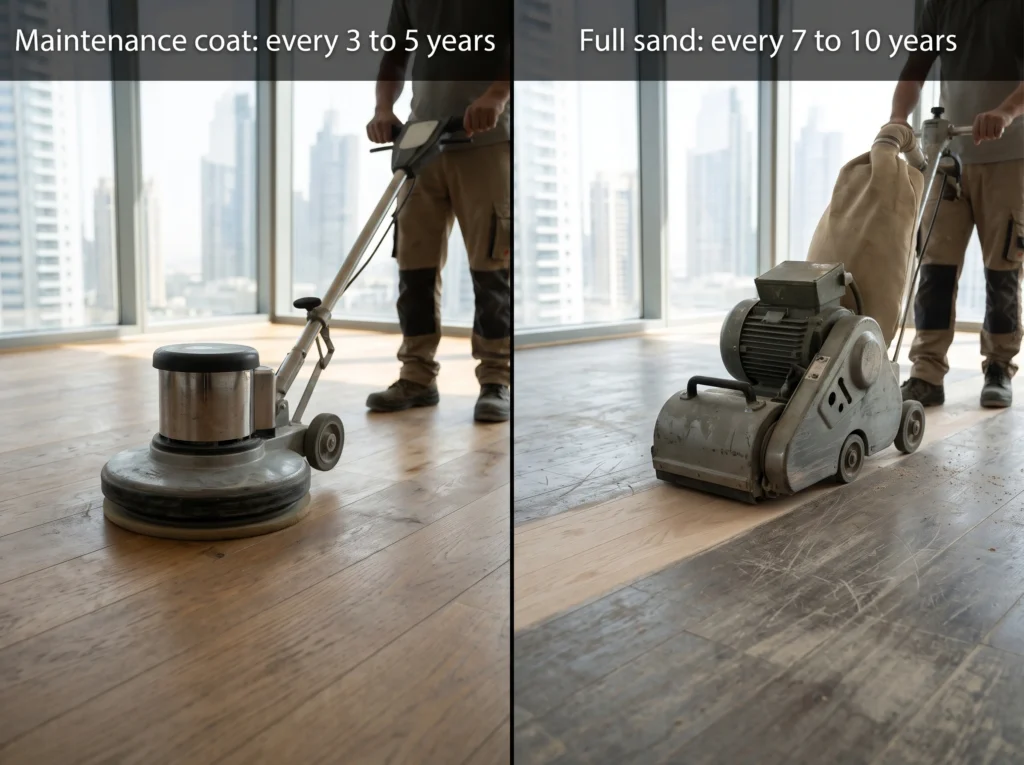
A full sand and refinish is usually needed every 7 to 10 years in a normal home. In between, a maintenance coat every 3 to 5 years keeps the finish healthy and pushes the next full sand further away. Both figures are NWFA guidance, as quoted by Kimminau Floors.
Full Sand or Maintenance Coat?
These are two very different jobs, and mixing them up wastes wood.
| Maintenance coat (screen and recoat) | Full sand and refinish | |
|---|---|---|
| What happens | The old finish is lightly scuffed, then a fresh coat goes on | The top of the wood is sanded off, then new finish goes on |
| Wood removed | Almost none | About 0.8 to 1.6 mm |
| When to choose it | Finish looks dull or worn, but the wood itself is fine | Scratches into the wood, grey patches, water stains |
If you only ever do full sands, you’ll use up your floor faster than you need to. A maintenance coat at the right time is the cheapest way to add years.
Putting It Together
Say your floor gets six full sands, roughly every 10 years. That’s about 60 years of sanding life before you count the years added by maintenance coats. Look after the finish well and you can push that much further. This is an estimate to show how the numbers connect, not a promise for any one floor.
How Long Does Solid Wood Flooring Last in Dubai?
The same rules apply here, but three local things can shorten the time between sands.
- Sand and grit. Fine sand on shoes acts like sandpaper and wears the finish down. Put mats at every door and sweep often.
- Humidity swings. Solid wood moves when humidity changes. Keep the AC running and aim for 35% to 65% humidity indoors. Cupped boards need heavier sanding to flatten, which uses up wood.
- Strong sun. Floor-to-ceiling windows fade wood over time. Blinds help, and a sand and refinish can even out the colour again.
Wondering if solid wood suits your home in the first place? Read our guide on whether solid wood flooring is good for Dubai.
How to Check How Much Wood Is Left?
Before you book a full sand, find out how much wood sits above the tongue. The NWFA advises measuring the wear layer in more than one spot.
- Find a place where you can see the side of a board, such as a floor vent, a threshold strip or the edge by a doorway.
- Measure from the top surface down to the top of the tongue.
- Check a few rooms, especially busy ones like hallways.
- If you can see the tongue, nail heads or very little wood on top, don’t sand. Ask a professional to look first.
Signs Your Floor Needs Sanding
- Grey or dark patches where the finish has worn through
- Scratches you can feel with a fingernail
- Water stains or black marks in the wood
- A rough, dry feel even after cleaning
If the floor just looks dull and none of these apply, try a maintenance coat first.
Solid, Semi-Solid or Engineered: How Many Sandings?
| Floor type | What’s on top | Sanding |
|---|---|---|
| Solid wood | One piece of wood, about 6 mm or more above the tongue | 6 to 8 times for most floors |
| Semi-solid | A thick real wood top on a stable core | Depends on the top layer, ask for the data sheet |
| Engineered | A thinner real wood top on a multi-layer core | Only if the top is at least 2.4 mm, often 1 to 3 times |
If you want real wood that moves less in Dubai’s AC, look at engineered wood flooring or a semi-solid option like Barlinek semi-solid herringbone. Check the top layer if you want to sand it later.
So, Is Solid Wood Worth It?
If you plan to stay in your home for a long time, yes. Few floors can be refreshed so many times. You pay more up front, but a well-kept solid floor can outlast several cheaper floors. It also suits classic patterns like parquet flooring and herringbone flooring. See our full range of solid wood flooring, or compare prices in our Dubai flooring price guide.
Frequently Asked Questions
How long does solid wood flooring last?
With good care and refinishing, many decades. Refinishing companies often quote 80 to 100 years or more. Without any refinishing, expect closer to 20 to 30 years.
How many times can you sand a solid wood floor?
Most solid floors can be sanded six to eight times, according to the NWFA. Careful sanding on a flat floor gets you more; heavy sanding gets you fewer.
How often should wood floors be refinished?
A full sand every 7 to 10 years, with a maintenance coat every 3 to 5 years in between.
Can you sand an engineered wood floor?
Sometimes. The NWFA advises against sanding if the real wood top is thinner than 2.4 mm. Thicker tops can usually take one to three sands.
Does sanding weaken a wood floor?
Not while there’s enough wood above the tongue. Each sanding removes a little, so the floor only becomes a problem when it gets close to the tongue.
How We Got These Numbers
1. Sanding Limits
The six-to-eight sandings figure, the 1/32 to 1/16 inch per sanding and the 2.4 mm engineered limit come from the NWFA’s technical lead, writing in Hardwood Floors magazine.
2. Lifespan and Refinishing Intervals
The 80–100+ year and 20–30 year lifespans, and the 7–10 year and 3–5 year intervals, come from Kimminau Floors, which credits the NWFA for the intervals. The engineered “1 to 3 times” figure comes from House Digest. The 35–65% humidity range comes from wood flooring industry guidance.
Planning a Solid Wood Floor?
Book a Free Site Visit
We’ll come to your home, check the room and the floor underneath, and bring samples of solid, semi-solid and engineered wood so you can compare them side by side.
- WhatsApp or call: +971 52 553 4055
- Email: info@dubaiflooringco.com
- Visit: 26th St, Al Quoz First, Dubai
- Or use our contact page